
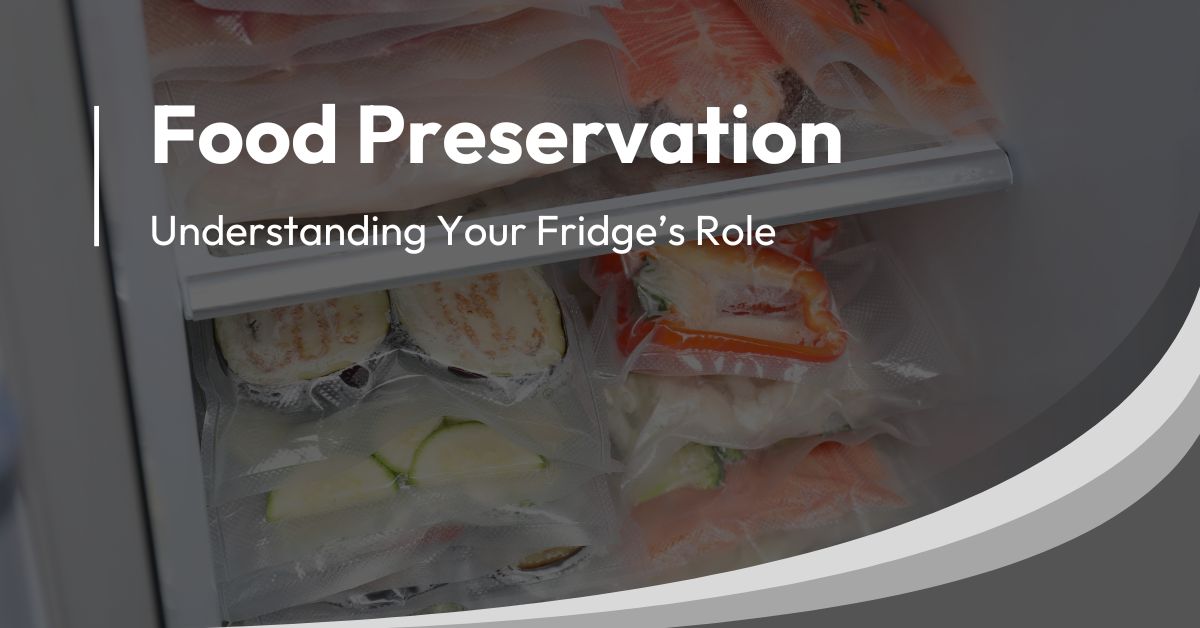
A refrigerator helps food remain usable by slowing many of the changes that lead to spoilage and foodborne illness. It controls temperature, supports appropriate storage conditions, and gives households more time to use perishable ingredients safely.
Refrigeration does not sterilize food, reverse spoilage, or make leftovers safe indefinitely. Some microorganisms can survive—and occasionally grow slowly—at refrigerator temperatures. Food handling, packaging, storage time, and the condition of the appliance still matter.
Quick answer: Refrigeration preserves food mainly by keeping it cold enough to slow microbial growth, enzyme activity, oxidation, moisture loss, and other quality changes. Keep the refrigerator at 40°F or below and the freezer at 0°F. Store food promptly, prevent raw-food leaks, use suitable containers, and follow reliable storage-time guidance.
What Does Food Preservation Mean?
Food preservation refers to methods used to maintain food safety, quality, or usability for longer than would otherwise be possible.
Common preservation methods include:
- Refrigeration
- Freezing
- Canning
- Drying
- Pickling and acidification
- Fermentation
- Curing and smoking
- Packaging that limits moisture or oxygen exposure
These methods do not work in the same way. Refrigeration primarily slows biological and chemical processes. It usually does not make food shelf-stable.
Home canning, drying, fermentation, and pickling require tested procedures because incorrect processing can create serious food-safety risks. Use research-based instructions rather than inventing processing times, ingredient ratios, or jar-sealing methods.
How Refrigeration Preserves Food
A refrigerator influences several processes at the same time. The result is slower deterioration—not complete prevention.
1. It Slows the Growth of Many Microorganisms
Bacteria, yeasts, and molds contribute to food spoilage. Some microorganisms can also cause foodborne illness without creating an obvious smell, color change, or visible mold.
Cold temperatures slow the growth of many bacteria. This is why perishable food should be kept at 40°F or below.
Refrigeration does not eliminate all microorganisms. Some, including Listeria monocytogenes, can grow slowly at refrigerator temperatures. Time limits, cleanliness, separation, and safe handling therefore remain important.
2. It Slows Natural Enzyme Activity
Foods contain naturally occurring enzymes that continue changing color, texture, flavor, and ripeness after harvest or processing.
Lower temperatures slow many of these reactions. Refrigeration can therefore delay softening, browning, flavor loss, and over-ripening in foods suited to cold storage.
Cold temperatures can also damage some produce. Bananas, tomatoes, potatoes, onions, and other foods may develop undesirable texture or flavor when stored incorrectly. Refrigeration is useful only when the food is suited to that environment.
3. It Slows Some Chemical Reactions
Oxidation can contribute to rancidity, color changes, flavor loss, and nutrient degradation. Cold temperatures slow many chemical reactions, including oxidation.
The refrigerator itself does not remove oxygen from food. Suitable packaging, covered containers, and reducing unnecessary air exposure provide additional protection.
For example, wrapping cut produce, closing opened packages, and covering leftovers can help limit drying, odor transfer, contamination, and exposure to air.
4. It Helps Control Moisture Loss and Humidity
Food can lose moisture in the refrigerator, becoming dry, wilted, or tough. Other foods release moisture and create condensation that encourages quality loss or mold.
Packaging and crisper drawers help manage these differences. Many refrigerators include humidity controls, but the labels and operation vary by model.
In general:
- Leafy vegetables often benefit from higher humidity that reduces wilting.
- Some fruits release ethylene and benefit from greater ventilation.
- Cut produce should usually be covered or placed in suitable containers.
- Visible condensation should not be allowed to pool around food.
Follow the refrigerator manual and food-specific storage guidance rather than assuming every crisper drawer works identically.
Food Safety and Food Quality Are Different
A food may lose quality before it becomes unsafe, or it may become unsafe without looking spoiled.
| Food Safety | Food Quality |
|---|---|
| Concerns microorganisms or conditions that may cause illness | Concerns flavor, smell, appearance, texture, and freshness |
| Unsafe food may look and smell normal | Quality loss is often visible or noticeable |
| Cannot always be judged with the senses | Often judged partly through the senses |
| Requires temperature, handling, and time controls | Improved through packaging and suitable storage conditions |
Do not taste questionable food to determine whether it is safe. Smell and appearance can reveal spoilage, but their absence does not prove safety.
The Correct Refrigerator and Freezer Temperatures
FDA and USDA guidance recommends maintaining:
- Refrigerator: 40°F or below
- Freezer: 0°F or below
A refrigerator target near 37°F can provide a practical margin below the 40°F limit, but verify the actual temperature with an appliance thermometer.
The numbered control does not necessarily show degrees. A setting marked “3,” “cold,” or “recommended” may produce different temperatures depending on the appliance, room conditions, food load, and door use.
Check temperatures periodically and whenever:
- Food feels warmer than usual
- Food begins freezing in the refrigerator
- A door has been left open
- The appliance loses power
- A large grocery order has been added
- The refrigerator is moved or its settings are changed
- The compressor or fans appear to behave differently
See our guide to signs that a refrigerator is not keeping food safely cold if temperatures remain above the safe limit.
Why Refrigerated Food Still Has a Time Limit
Cold storage slows change but does not stop it. Microorganisms may continue growing slowly, enzymes continue acting, moisture moves, fats oxidize, and food quality declines.
Storage time depends on:
- The type of food
- Whether it is raw or cooked
- How fresh it was when stored
- The refrigerator temperature
- Packaging and contamination
- How long it remained unrefrigerated
- Whether it was opened, cut, or prepared
There is no universal rule such as “all leftovers last one week.” Cooked leftovers are generally used within three to four days under USDA guidance, but other foods may have shorter or longer recommended periods.
Use our cold-storage guide for common foods and the official FoodKeeper resource when checking a specific item.
How Packaging Supports Refrigeration
Packaging does several jobs that cold temperature alone cannot perform.
- Limits moisture loss
- Reduces exposure to air
- Contains raw-food juices
- Protects food from physical damage
- Reduces odor transfer
- Makes preparation and storage dates easier to track
- Helps prevent contact with contaminated surfaces
Use food-storage containers or wrapping suited to the product. A container should be clean, in good condition, and able to close securely.
Do not automatically transfer every product from its original package. The package may carry allergen information, preparation instructions, storage directions, lot numbers, and recall details.
Why Refrigerator Airflow Matters
A refrigerator must circulate cold air. Blocking outlets or return vents can create warm and freezing zones even when the control appears correctly set.
Avoid:
- Packing food tightly against visible vents
- Pressing containers against the rear cooling surface
- Covering an internal fan outlet
- Overloading shelves so air cannot move between foods
- Allowing heavy frost to obstruct an air channel
An organized refrigerator can improve visibility and airflow, but it does not need to look empty. Our refrigerator organization guide explains how to create practical zones without blocking cooling.
Where Should Different Foods Be Stored?
The exact temperature pattern varies by refrigerator design. Use the appliance manual and thermometer readings rather than assuming every top shelf, drawer, or rear corner has the same temperature.
| Food or Area | Practical Storage Guidance |
|---|---|
| Ready-to-eat food | Keep covered and separated from raw-food leakage |
| Raw meat, poultry, and seafood | Keep securely wrapped or in a leak-resistant container below ready-to-eat foods |
| Eggs | Keep in their carton in the main refrigerator compartment rather than the door |
| Milk and highly perishable dairy | Store in the main compartment where temperature is more stable |
| Condiments | The door may be suitable when the label permits refrigeration under normal temperature variation |
| Produce | Use appropriate drawers, packaging, and humidity settings for the specific fruit or vegetable |
| Leftovers | Cover, date, and place where they remain visible |
Do not rely on the bottom shelf alone to contain raw-food leakage. Use secure packaging or a washable container as an additional barrier.
How to Cool and Refrigerate Leftovers Safely
Do not leave cooked food at room temperature until it is completely cold.
Refrigerate perishable food within two hours of cooking or purchasing. When the surrounding temperature is above 90°F, refrigerate it within one hour.
For large quantities:
- Divide the food into smaller portions.
- Use shallow containers that allow faster cooling.
- Place the containers in the refrigerator promptly.
- Avoid stacking hot containers so tightly that cold air cannot move around them.
- Cover the food according to the storage procedure and food type.
- Add a preparation date when the food will not be used immediately.
A deep stockpot of soup or stew cools slowly. Dividing it into shallow containers is safer than leaving the whole pot on the counter for several hours.
How Freezing Preserves Food
Freezing at 0°F greatly slows microbial growth and chemical reactions. It can extend storage much longer than ordinary refrigeration.
Freezing does not reliably kill every microorganism. When food thaws, surviving microorganisms can become active again. Food should therefore be handled safely before freezing, during thawing, and after thawing.
Freezer-storage recommendations often concern quality rather than safety. Food kept continuously frozen at 0°F can remain safe for very long periods, but flavor, texture, color, and moisture may deteriorate.
Quality depends on:
- How fresh the food was before freezing
- Packaging quality
- Air exposure
- Temperature stability
- The food’s water and fat content
- How it is thawed and prepared
Use our A-to-Z freezing guide for food-specific preparation, packaging, thawing, and quality guidance.
What Refrigerator Preservation Cannot Do
A refrigerator is not a universal solution for food safety. It cannot:
- Make spoiled food fresh again
- Make food safe after excessive time at unsafe temperatures
- Remove toxins that may already be present
- Kill every bacterium, mold, parasite, or virus
- Prevent contamination from hands, utensils, surfaces, or leaking packages
- Guarantee indefinite storage
- Correct unsafe home-canning or preservation methods
- Protect food when the appliance cannot maintain temperature
Placing questionable food in a colder location does not reset its safety history.
Refrigerator Preservation Quick Reference
| Preservation Factor | What the Refrigerator Does | What You Must Still Do |
|---|---|---|
| Microorganisms | Slows growth of many organisms | Use safe temperatures, clean handling, and storage-time limits |
| Enzymes | Slows natural breakdown and ripening | Store foods suited to refrigeration |
| Oxidation | Slows chemical reactions | Use suitable wrapping or closed containers |
| Moisture | Provides drawers and a controlled cold environment | Choose appropriate packaging and humidity settings |
| Cross-contamination | Provides separate shelves and compartments | Contain raw foods and clean spills promptly |
| Storage life | Extends usability compared with room-temperature storage | Follow food-specific storage guidance |
| Freezing | Greatly slows microbial and chemical activity | Package, freeze, thaw, and cook food safely |
What Happens During a Power Outage?
Keep the refrigerator and freezer doors closed as much as possible.
FDA guidance indicates that an unopened refrigerator generally keeps food cold for about four hours. A full freezer may hold temperature for approximately 48 hours, while a half-full freezer may last about 24 hours.
These are general estimates rather than guarantees. Actual results depend on the appliance, room temperature, food load, starting temperature, insulation, and door openings.
After power returns:
- Check appliance and food temperatures.
- Do not taste food to determine safety.
- Discard refrigerated perishable food that has remained above 40°F for four hours or more.
- Frozen food that still contains ice crystals or remains at 40°F or below may generally be refrozen or cooked.
- Discard food when its time or temperature history cannot be determined safely.
Simple Habits That Improve Food Preservation
- Keep appliance thermometers in the refrigerator and freezer.
- Refrigerate perishable groceries promptly.
- Divide large amounts of cooked food into shallow containers.
- Cover or wrap foods appropriately.
- Label leftovers with preparation dates.
- Store raw meat, poultry, and seafood so they cannot leak onto other foods.
- Keep eggs in their carton in the main compartment.
- Keep internal air vents clear.
- Review older food before grocery shopping.
- Clean spills promptly using an appropriate method.
- Follow storage guidance for each food rather than relying on one universal time limit.
Frequently Asked Questions
Does refrigeration kill bacteria?
No. Refrigeration slows the growth of many bacteria but does not reliably kill them. Some organisms can survive or grow slowly at refrigerator temperatures.
Does freezing kill bacteria?
Not reliably. Freezing stops or greatly slows growth while food remains frozen, but surviving microorganisms can become active again after thawing.
Why does refrigerated food still spoil?
Cold temperatures slow microbial growth, enzymes, oxidation, and moisture changes but do not stop them completely. Storage time, packaging, contamination, and refrigerator temperature also affect deterioration.
Can hot food go directly into the refrigerator?
Yes. Divide large quantities into smaller, shallow containers and refrigerate promptly. Do not leave perishable food out until it reaches room temperature.
Why should eggs not be stored in the refrigerator door?
The door experiences greater temperature variation than the main compartment. FDA guidance recommends storing eggs in their carton in the main refrigerator section.
Does an airtight container make food last indefinitely?
No. A suitable container can reduce moisture loss, air exposure, odors, and contamination, but it does not eliminate microorganisms or remove food-specific storage limits.
Is visible mold the only sign that food is spoiled?
No. Food may show odor, color, texture, gas, slime, liquid, or packaging changes. Foodborne pathogens may also be present without obvious spoilage signs.
Final Takeaway
A refrigerator preserves food by slowing microbial growth, enzyme activity, oxidation, moisture loss, and other forms of deterioration. It gives you more time to use perishable food, but it does not make food permanent or sterile.
Keep the refrigerator at 40°F or below, use the freezer at 0°F, store perishable food promptly, contain raw-food leaks, preserve airflow, and follow food-specific storage guidance.
The safest system combines reliable refrigeration with good packaging, careful handling, clear dates, routine temperature checks, and timely use or freezing.

Leave a Reply